
Andy Dominianni Was Offered Documents, a Chance to Investigate The Spearman Stops From a Retired BCPD Detective Whistle-Blower— But the Questions Were Never Asked
FAFO Justice Investigative Op/Ed
For years, the media has told the public that they are the watchdogs. They tell us they hold government accountable.They tell us they challenge those in power.They tell us they seek the truth—even when that truth is uncomfortable.
So I decided to put that claim to the test.
At Channel 3 News, I presented exactly what investigative journalists say they want: evidence, documentation, leads, and access to a Battle Creek Police Department Whistle-blower who could provide information regarding serious allegations involving the Battle Creek Police Department and local government.
I did not walk in asking for a headline. I did not walk in demanding they agree with me. I walked in asking them to do their job. Look at the evidence. Ask the questions. Investigate.
After attempting to send my files and information via email and being unsuccessful because the files were too large, I decided to stop by the station in person.
So I did.

|
Dabble VoIP
Business phone for less |
Get Started - mention FAFO for 10% off |
I arrived with the evidence in hand on a flash drive. I had documentation ready to provide. I had additional information ready to discuss. I had a Battle Creek Police Department whistleblower on speed dial—ready and willing to speak directly with a reporter.
I also brought something else:
An Affidavit of Truth and Impartiality in Journalism prepared for reporter Andy Dominianni.
Because journalism is built on principles. Truth. Accuracy. Fairness. Impartiality. Accountability.
I waited.
For approximately 45 minutes, I sat in the lobby waiting for Andy Dominianni to come out so I could personally provide the affidavit and discuss the information I had brought.
He never came out.
Instead, a news manager came to speak with me. Before taking the time to understand why I was there, the conversation quickly shifted toward telling me to send the information through email.
The problem?
That was exactly what I had already explained was not possible.
The files were too large.
That was why I was standing there in person—with the evidence physically in my possession. I wasn’t asking them to blindly believe me. I was offering them the opportunity to examine the material themselves. I was offering them access to a source. I was offering them the chance to ask questions.
|
Need I.T. Support?
Express IT Solutions — Fast & Reliable. |



|
Get Support |
But those opportunities were not taken.
The flash drive was not reviewed. The whistle-blower was not interviewed. The evidence was not reviewed. No investigative questions were asked. No follow-up meeting was scheduled.
Instead, the discussion centered around a reporter who did come out to speak with me briefly, defending the station’s previous reporting rather than examining whether there was additional information that deserved review. That should concern anyone who believes in the importance of a free press.
Because journalism is not supposed to begin with a conclusion. Journalism is supposed to begin with questions. A reporter’s responsibility is not to protect an existing narrative. A reporter’s responsibility is to test it.
The strongest reporting doesn’t come from only talking to people who confirm what you already believe. It comes from examining all available information, including evidence that challenges previous assumptions.
History has shown us that many of the biggest stories in journalism began with someone bringing forward information that powerful people did not want examined.
whistle-blowers have exposed corruption, misconduct, abuse of authority, and failures of government institutions because someone was willing to listen.
The public does not benefit when evidence is dismissed before it is reviewed. The public does not benefit when sources are ignored before they are questioned. The public does not benefit when institutions receive scrutiny from only one direction.
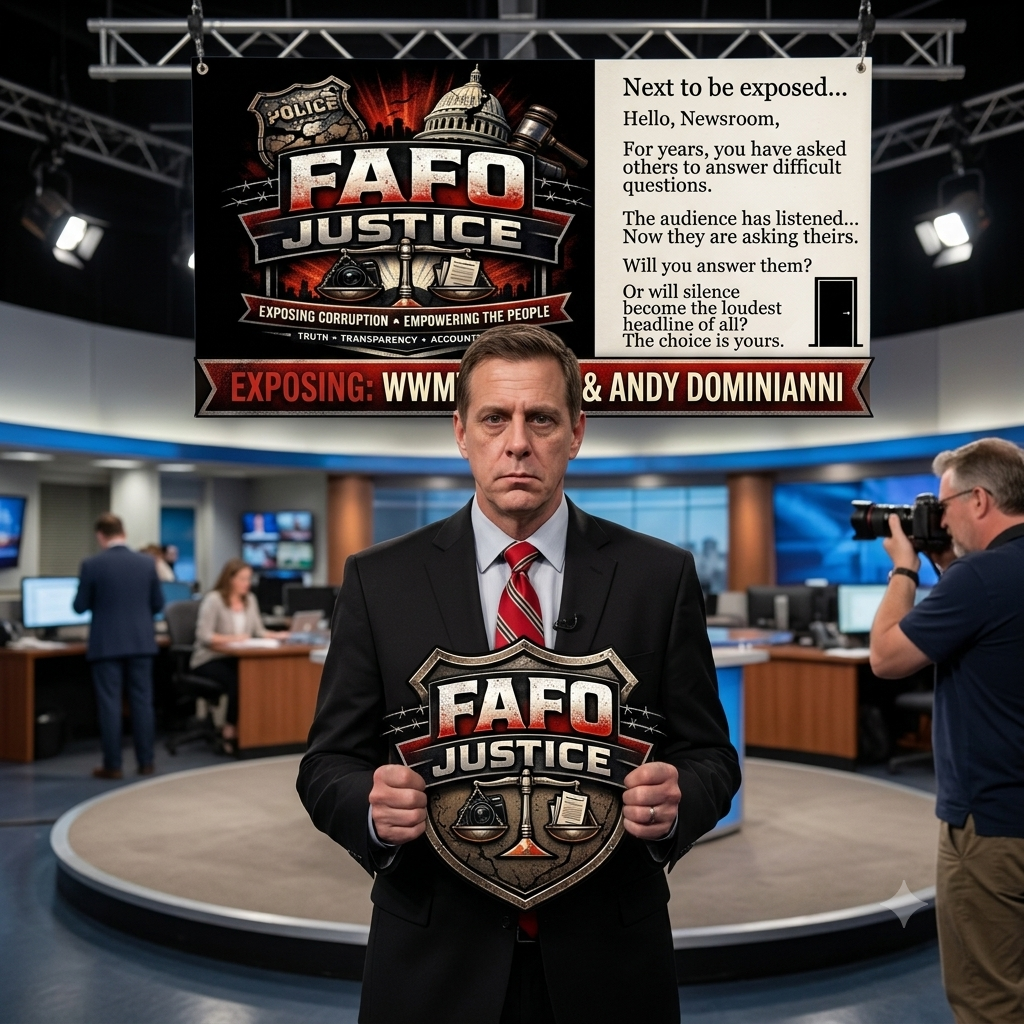
Before leaving, I handed the news manager the Affidavit of Truth and Impartiality in Journalism and asked that it be given to Andy Dominianni.
I made one thing clear:
I did not expect him to sign it.
But I did expect him to read it.
I asked that he consider those principles before every broadcast and strive to uphold the standards that journalism claims to represent.
Those standards are simple:
Seek the truth. Remain impartial. Question those in power. Verify information. Correct mistakes. Follow evidence wherever it leads.
Give the public the complete picture—not just the official version.
At FAFO Justice, we believe accountability applies to everyone.
Government officials.
Law enforcement.
Prosecutors.
Judges.
And yes—the media.
No newsroom is above scrutiny.
No reporter is beyond accountability.
No institution deserves automatic trust.
Trust is earned through transparency, fairness, and a willingness to examine facts—even when those facts are inconvenient.
If the evidence I brought does not support the concerns raised, then investigate it and report that. If the whistle-blower’s information does not hold up, then interview them, verify the facts, and explain why. But refusing to look at evidence or speak with a willing source before making that determination does not serve the public.
It protects a narrative.
The people of Battle Creek deserve journalism that is fearless enough to challenge power, humble enough to reconsider conclusions, and committed enough to follow the facts wherever they lead.
FAFO Justice will continue doing what we have always done:
Filing FOIAs.
Reviewing records.
Interviewing sources.
Following evidence.