
When a Police Department’s Own Policies Raise Questions, The City Doesn’t Get to Outsource Accountability to the Citizens
By Autumn Smith
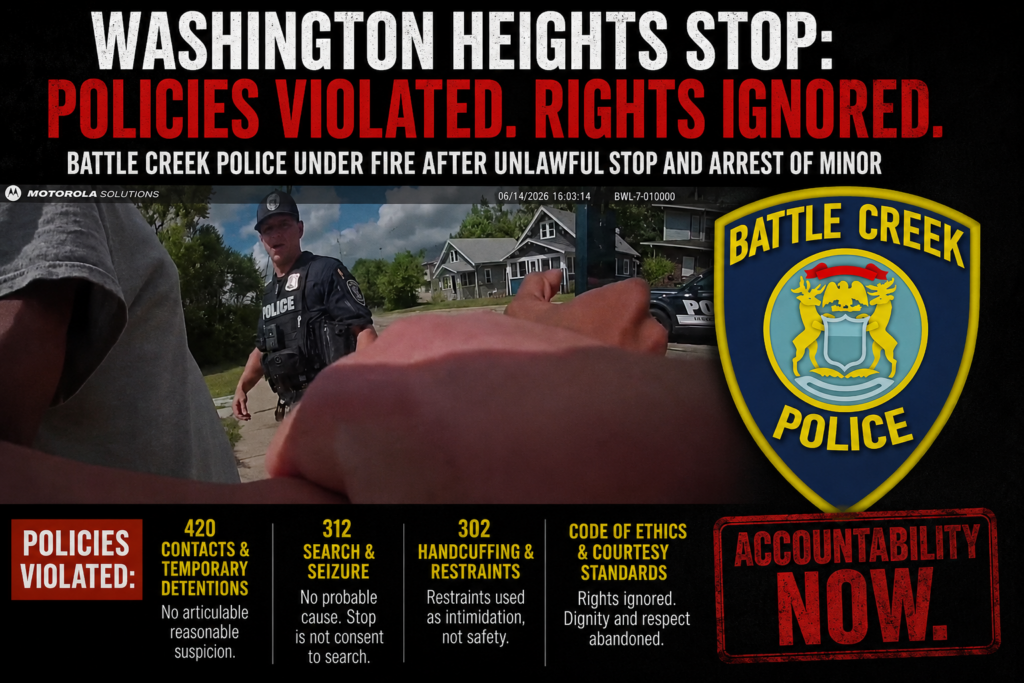
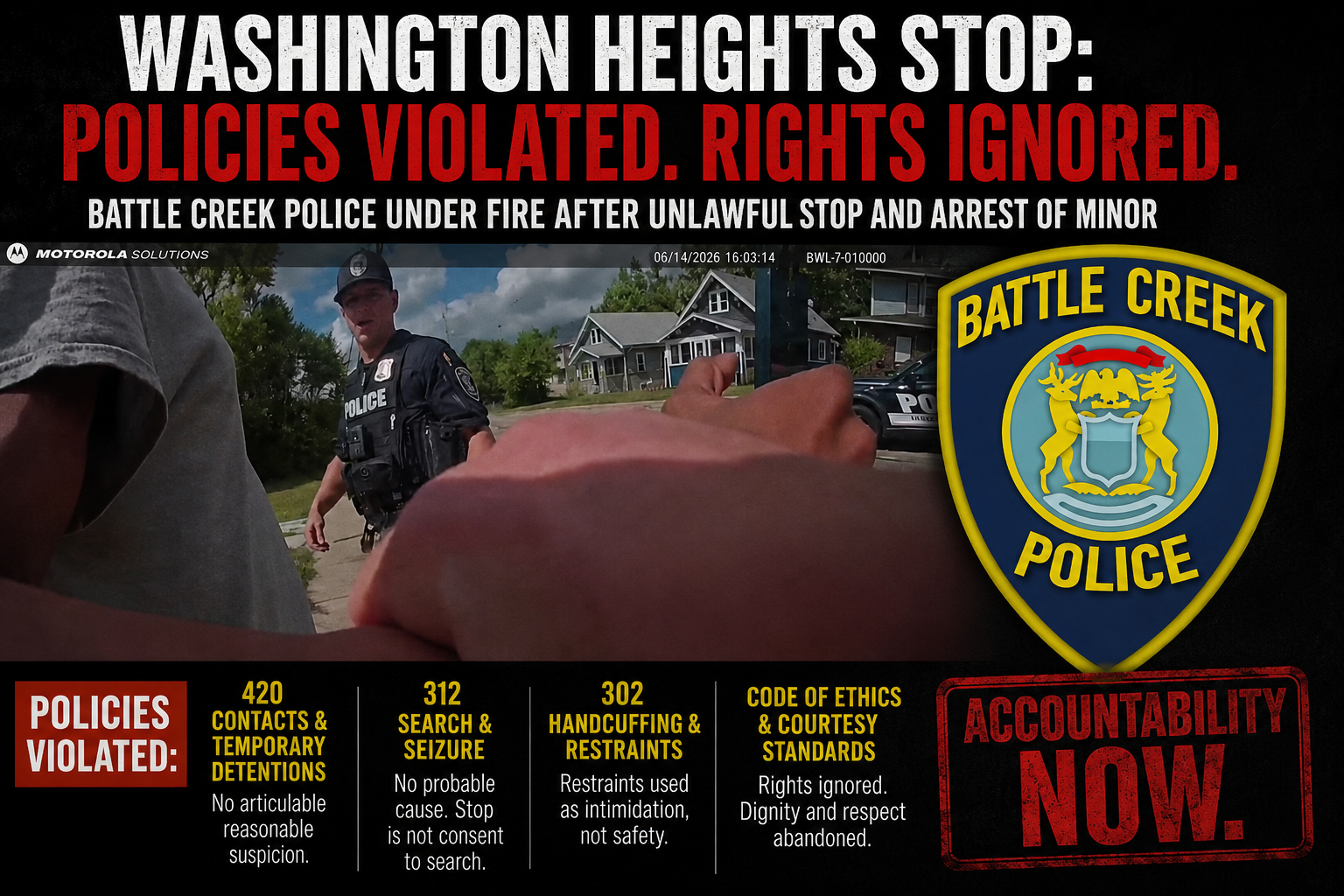
The Battle Creek Police Department has spent years telling the public that policies, training, and accountability matter.But when a juvenile in Washington Heights was detained, handcuffed, searched, and arrested under circumstances now being publicly questioned, the response from city leadership was not immediate accountability.
Instead, Mayor Mark Behnke essentially asked the public to decide whether policies were violated.
Let that sink in.
The City of Battle Creek has a police department. The City has supervisors. The City has command staff. The City has a policy manual. The City has an internal review process. So why is the public being asked to play investigator?
Why is the question not:
“Did our officers follow department policy, and if not, what corrective action is required?”

|
Dabble VoIP
Business phone for less |
Get Started - mention FAFO for 10% off |
Why is it:
“Tell us if you think they violated policy”?
That is not accountability. That is outsourcing accountability. And the irony is this: the policies already answer the questions:
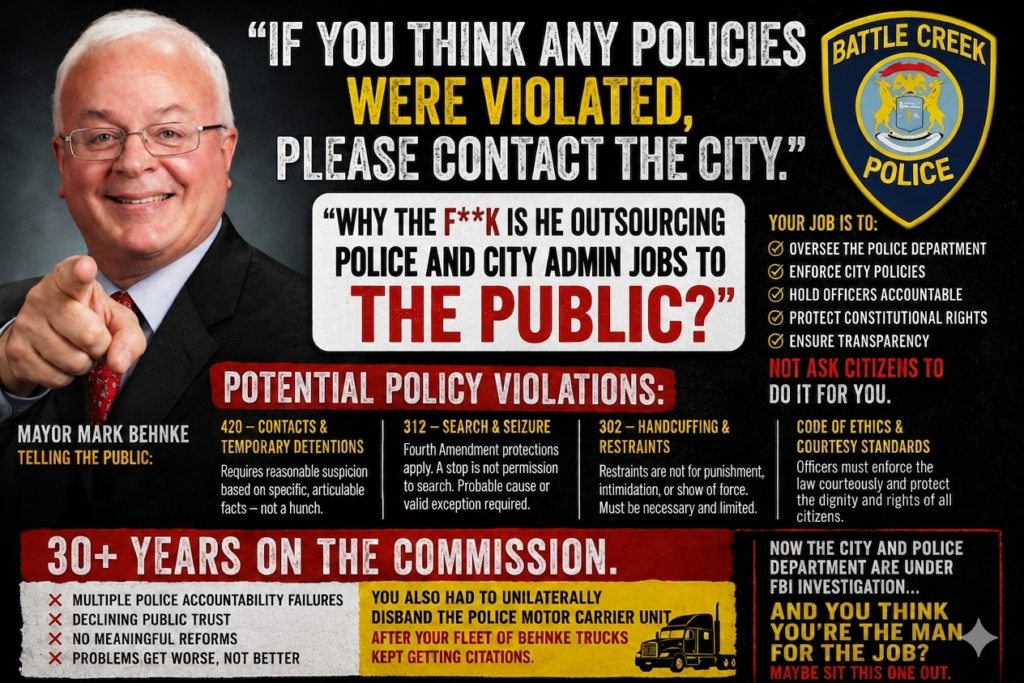
BCPD POLICY 420 — CONTACTS AND TEMPORARY DETENTIONS
This is where the entire incident begins. Before you can search someone, handcuff someone, or arrest someone, the first question is: Was the initial detention lawful?
BCPD Policy 420 exists specifically to answer that. The policy recognizes officers can have consensual encounters with citizens. But the moment a person is no longer free to leave, the constitutional standard changes.
A detention requires:- reasonable suspicion- based on articulable facts- connecting the person to possible criminal activity Not:- a hunch- a feeling- curiosity- “something seemed off”- stereotypes- assumptions. The policy requires facts. Actual facts. The officer must be able to explain: “What specific facts made you believe this individual was involved in criminal activity?”
Not: “Because he looked suspicious.”Not:“Because he was in a certain neighborhood.” Not:“Because he touched his waistband.” Those things alone do not automatically create reasonable suspicion.
Policy 420 also states: A person shall not be detained longer than reasonably necessary to resolve the officer’s suspicion. Meaning: A temporary investigation cannot become a fishing expedition.
POLICY 312 — SEARCH AND SEIZURE:
This is the Fourth Amendment policy. The policy that governs searches of people, property, vehicles, and evidence. BCPD’s own language recognizes: The Fourth Amendment protects citizens from unreasonable searches and seizures.
Officers generally need:- a warrant- probable cause- lawful justification. Probable cause is not a guess. It is not a hunch. It requires a reasonable belief based on reliable information that evidence of a crime is probably present.
|
Need I.T. Support?
Express IT Solutions — Fast & Reliable. |



|
Get Support |
Policy 312 specifically requires searches to be:- constitutional- limited in scope- limited in time and area- connected to the legal justification.
Translation: A legal stop is not a blank check.A person being detained does not automatically become searchable. A police officer cannot say: “I stopped you, therefore I can search you.”
That is not how the Constitution works.
THE WAISTBAND QUESTION:
The department’s own policies require a deeper question:
Was there a legitimate safety concern supported by facts? Policy 420 allows a pat-down only when there are specific reasons to believe a person may be armed and dangerous. A frisk is not:- evidence gathering- a general search- a way to find something illegal. It is a safety measure.
The question is: Was there a specific, articulable reason to believe this juvenile was armed? Or was an assumption made?
Because assumptions are exactly what constitutional protections are designed to prevent.
POLICY 302 — HANDCUFFING AND RESTRAINTS
This is where the escalation matters.
BCPD Policy 302 makes clear:
Handcuffs are not a punishment. They are not a compliance tool. They are not a way to show authority. The policy states restraints should not be used to:- punish- intimidate- display authority That matters. Because being detained is not the same thing as being arrested.
Policy 302 specifically addresses detainees. A person can be temporarily detained and later released without arrest. But restraints must:- be reasonably necessary- continue only as long as justified- be balanced against the intrusion on the person
The question is simple:
Even if the stop was justified — was handcuffing this minor justified? Was there an actual safety concern? Or was the restraint itself an unnecessary escalation?
THE POLICY VIOLATION CHECKLIST
The public does not have to rewrite the rules. BCPD already wrote them. The questions are: Policy 420:
1. What were the specific articulable facts?
2. What crime was suspected?
3. How was this individual connected to that suspected crime?
4. Was the detention longer than necessary?
Policy 312
1. What legal authority justified the search?
2. Was there probable cause?
3. Was consent voluntary?
4. Was the search limited?
Policy 302
1. Why were restraints used?
2. What safety concern existed?
3. Was the juvenile treated as a detainee or as someone already convicted?
4. Were restraints removed when no longer necessary?
AND THEN THERE IS THE MOST IMPORTANT POLICY:
Courtesy, Dignity, and Respect.
BCPD’s own standards require officers to: safeguard rights- protect people from intimidation- enforce the law courteously- act without personal bias- treat people with dignity and respect. This is not about being “soft on crime.” This is about constitutional policing. A department can enforce laws and still respect the people it serves. Those two things are supposed to happen together.
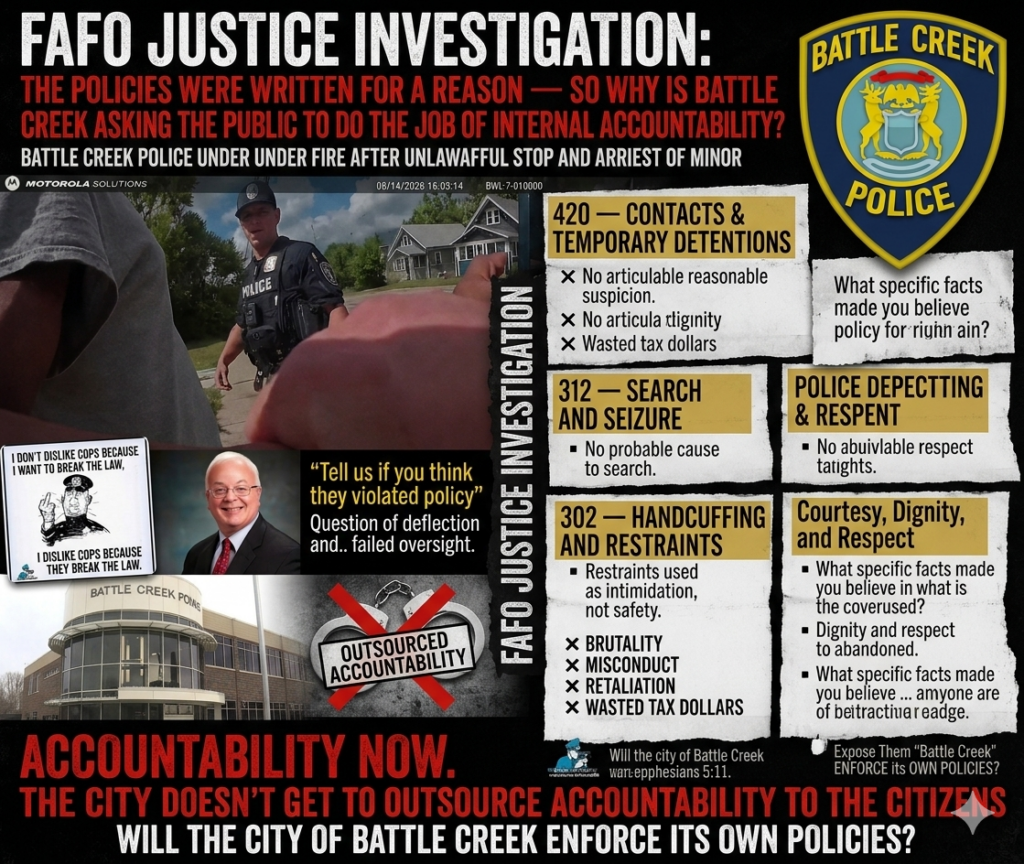
THE BIGGER ISSUE: WHO HOLDS THE CITY ACCOUNTABLE?
The City of Battle Creek cannot simultaneously claim: “We have policies.”and “We need the public to tell us if they were violated.”
That is not leadership. That is a failure of oversight.
The city has the authority to review.
The city has the ability to investigate.
The city has the responsibility to enforce its own standards.
The public’s role is not to replace internal accountability. The public’s role is to demand it. Because policies mean nothing if they only exist on paper. A policy manual sitting on a shelf is not accountability. A policy manual enforced equally — that is accountability.
Battle Creek citizens deserve answers. Not excuses. Not deflection. Not “tell us what you think.”
The question is not whether the public can find a policy violation.
The question is: Will the City of Battle Creek enforce the policies it already created?
Stay tuned as this story continues to unfold.