
By Autumn Smith
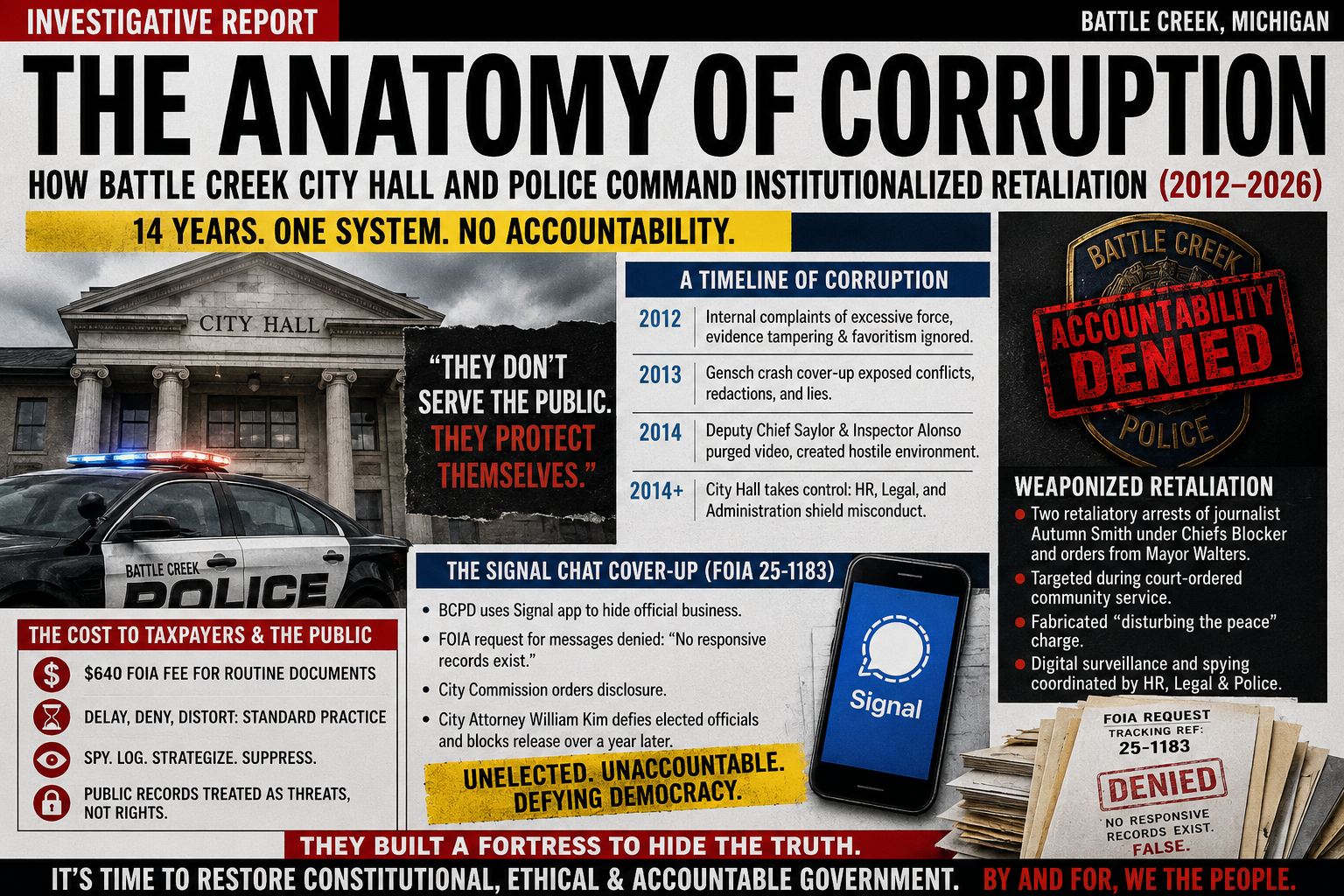
When an institution systematically corrupts its own mandate, it shifts from protecting the public to protecting itself. Over a fourteen-year period spanning 2012 to 2026, the City of Battle Creek and the Battle Creek Police Department (BCPD) ceased treating transparency as a constitutional duty. Instead, an evaluation of the historic timeline reveals that municipal authorities transformed public oversight into a legal battlefield, using the apparatus of City Hall to shield internal misconduct while actively hunting down whistleblowers and independent journalists who dared to expose the truth.
The Rot Within: A History of Executive Misconduct
The crisis did not emerge overnight; it trickled down from a compromised command structure that continuously prioritized self-preservation over public trust:
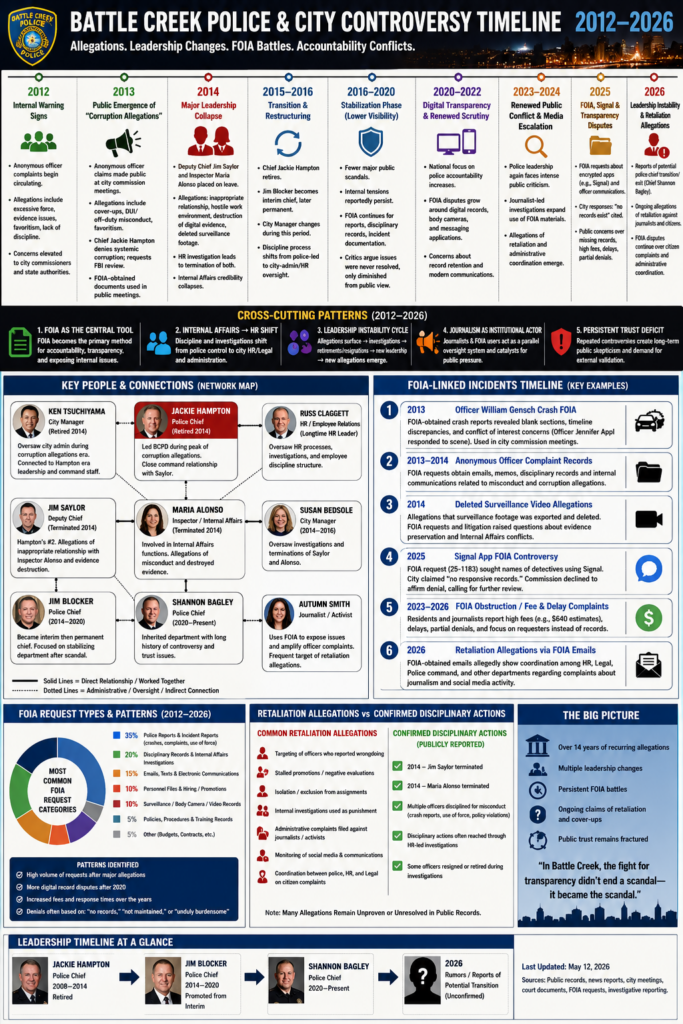
Internal Warning Signs (2012): The cycle began with internal officer complaints detailing excessive force, structural evidence tampering, and flagrant favoritism among top brass. Because internal resolution mechanisms were broken, these initial warnings were buried by command staff, forcing whistleblowers to look outward.
The 2013 Gensch Crash Cover-Up: The public first glimpsed the depth of the rot when FOIA-obtained records regarding an auto accident involving Officer William Gensch exposed redacted timelines and glaring conflicts of interest. Rather than correcting the fraudulent reporting, the department’s response focused on managing the political fallout at city commission meetings.
The 2014 Leadership Collapse: The moral failure of the department peaked when Deputy Chief Jim Saylor and Inspector Maria Alonso (head of Internal Affairs) were exposed for creating a hostile work environment and systematically purging internal surveillance footage. This catastrophic failure demonstrated that the very individuals tasked with investigating internal corruption were actively destroying the evidence of it.
The City Hall Realignment: Protection Over Accountability

|
Dabble VoIP
Business phone for less |
Get Started - mention FAFO for 10% off |
Following the 2014 scandals, City Hall executed a structural shift that critics argue permanently institutionalized corruption. Under the guise of reform, disciplinary and investigative authority was transferred away from a police-led Internal Affairs framework directly into the hands of City Administration, Human Resources, and City Legal Counsel. Rather than cleaning house, this realignment effectively weaponized City Hall.
Accountability was stripped of its public-facing obligations and replaced by corporate-style risk management. Human Resources and Legal Counsel became an administrative shield, utilizing taxpayer funds to suppress internal dissent and deny public record disclosures.
Weaponized and Repeated Retaliation Against the Press
External watchdogs fared no better than internal whistleblowers. Investigative journalist and activist Autumn Smith became a primary target of the municipal state, experiencing repeated, escalatory campaigns of physical and legal intimidation designed to break her resolve.
The First Retaliatory Arrest under Chief Blocker
Smith’s exposure of entrenched corruption sparked immediate pushback from top command. Her first retaliatory arrest, orchestrated during the tenure of Police Chief Jim Blocker, resulted in a highly controversial prosecution. Smith was ultimately court-ordered to perform community service as part of her sentence. In an ironic twist of justice, the terms of her community service allowed her to attend city commission meetings. Rather than being silenced, Smith used this mandatory attendance to sit in the front rows of City Hall and continue publicly exposing the department’s deep-seated corruption.
The Second Arrest: Mayor Walters and the BCPD
Humiliated by Smith’s resilience, municipal leadership escalated their tactics. While she was actively fulfilling her court-ordered community service, she was subjected to a second wave of state-sanctioned retaliation. Orchestrated by Mayor Dave Walters and vengeful members of the BCPD, Smith was targeted mid-service and arrested a second time on a fabricated charge of “disturbing the peace.” This double-arrest pattern made it clear that City Hall viewed the penal system not as a tool for public safety, but as a mechanism for political retribution. Autumn was ultimately acquitted and then filed a $5 million dollar First Amendment Retaliation and Malicious Prosecution lawsuit against the city.
Coordinated Administrative Spying
The intimidation extended deep into the digital realm. FOIA-obtained electronic correspondence from 2026 explicitly unmasked secret coordination between Human Resources, City Legal, and Police Command to spy on, log, and map out legal strategies against Smith and other local media members. The city’s FOIA processing unit shifted its focus from searching for records to investigating the motives of the journalists. They instituted bad-faith financial barriers, including a documented $640 fee assessment for routine paperwork, paired with systemic delays and false “no records exist” denials.
The Signal Chat Cover-Up and Legal Mutiny (FOIA 25-1183)
By 2025, the corruption had evolved to leverage modern technology. Faced with persistent public record requests, BCPD detectives and command staff began utilizing end-to-end encrypted messaging applications—specifically the Signal app—to conduct official, off-the-record city business and evade transparency laws.
|
Need I.T. Support?
Express IT Solutions — Fast & Reliable. |



|
Get Support |
When Autumn Smith filed a targeted FOIA request (Tracking Reference: 25-1183) demanding these official text strings and metadata, City Hall initially issued a blanket denial, claiming “no responsive records exist”. Smith aggressively fought this obstruction, and upon a formal appeal to the City Commission, the elected officials voted to reverse the denial in Autumn’s favor, legally ordering the disclosure of the communications.
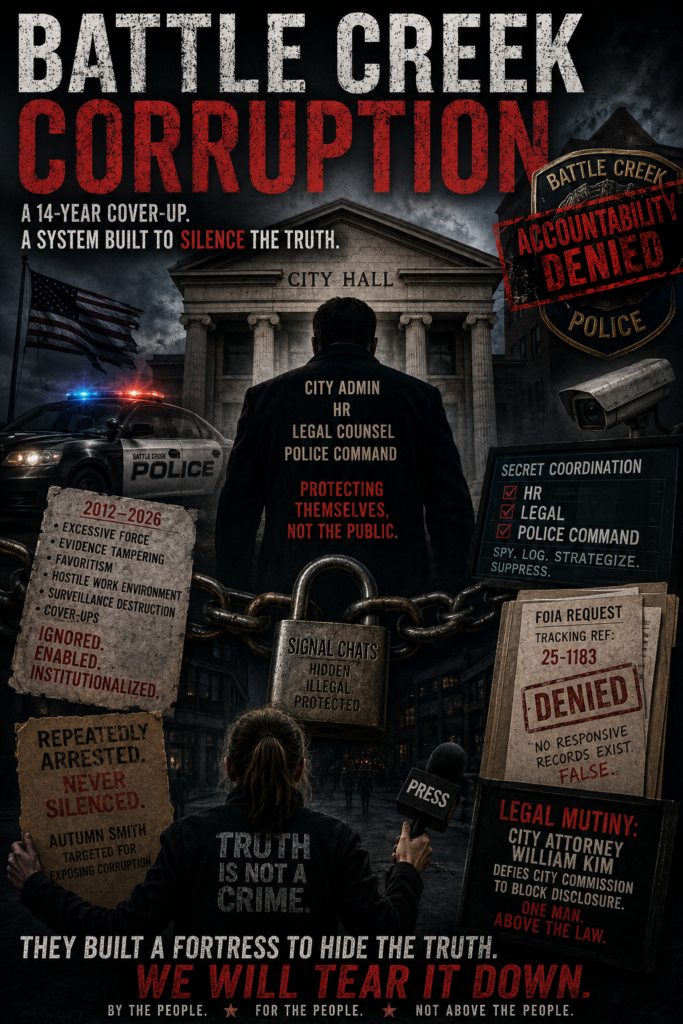
However, the victory exposed an even deeper layer of systemic corruption: an administrative mutiny against elected oversight. Over a year after the City Commission issued its directive order, City Attorney William Kim has flatly refused to comply with the mandate, single-handedly blocking the release of the Signal chats.
This ongoing stonewalling represents a constitutional crisis within Battle Creek, where an unelected city attorney openly defies the governing body to maintain a dark, unreviewable communication network out of the reach of the law.
Conclusion: A Fractured System
By mid-2026, it blatantly reveals a city administration completely detached from ethical governance. Executive leadership remains highly volatile, marked by the contentious, exit of Police Chief Shannon Bagley amidst renewed allegations of administrative retaliation.
In Battle Creek, corruption became institutionalized the moment City Hall chose to treat public information as an existential threat. By deploying high fee barriers, coordinated HR surveillance, repeated retaliatory arrests, and outright legal mutiny against elected officials, municipal leaders have made one thing clear: they do not serve the public; they rule over them from behind closed doors.
The persistent trust deficit cannot be repaired by installing another chief; it requires dismantling of the entire unethical governance that has been allowed to thrive and go unpunnished for years at city hall and in the police department. The weaponization and defensive legal fortress that City Attorney William Kim and City Hall have built to keep the truth from coming to light needs to end.
It’s time the city of Battle Creek and police department stops viewing and treating its citizens, activists, critics and journalists as enemy combatants and remembers who they work for and restore Constitutional, ethical and accountable government back to, By and For We The People.
###############
Join a upcoming community conversation about corruption. Listen to people who have been victimized by the police and court system. Share your story. Ask questions and connect with others. Open to the public. Detail on flyer below.