
By Autumn Smith | Op/Ed
What is unfolding inside the City of Battle Creek is not a misunderstanding, not a communication breakdown, and not “routine handling of a citizen complaint.” It is a documented pattern of multiple city departments converting a private grievance into a coordinated administrative response involving protected speech, journalist activity, and internal government resources—triggering serious questions under both City policy and constitutional law.
At the center of the matter is a private citizen complaint submitted by Kris Douponce regarding a journalist and the sharing of publicly available reporting. Rather than treating this as a private dispute with no governmental jurisdiction, the matter was elevated into City operations involving HR, administration, legal counsel, police leadership, code compliance, and FOIA staff.
The individuals involved include but not limited to: Michelle Hull (HR Director), Amanda Zimmerlin (City Manager), Marcie Gillette (Assistant City Manager), Jason Francisco (Community Development Director, formerly Code Compliance), William Kim (City Attorney), Patrick Batterson & Marcel Stozel (Assistant City Attorney), Police Chief Shannon Bagley, Captains Joel Case and Jim Martens, FOIA personnel, and Mayor Mark Behnke as the ultimate supervisory authority.
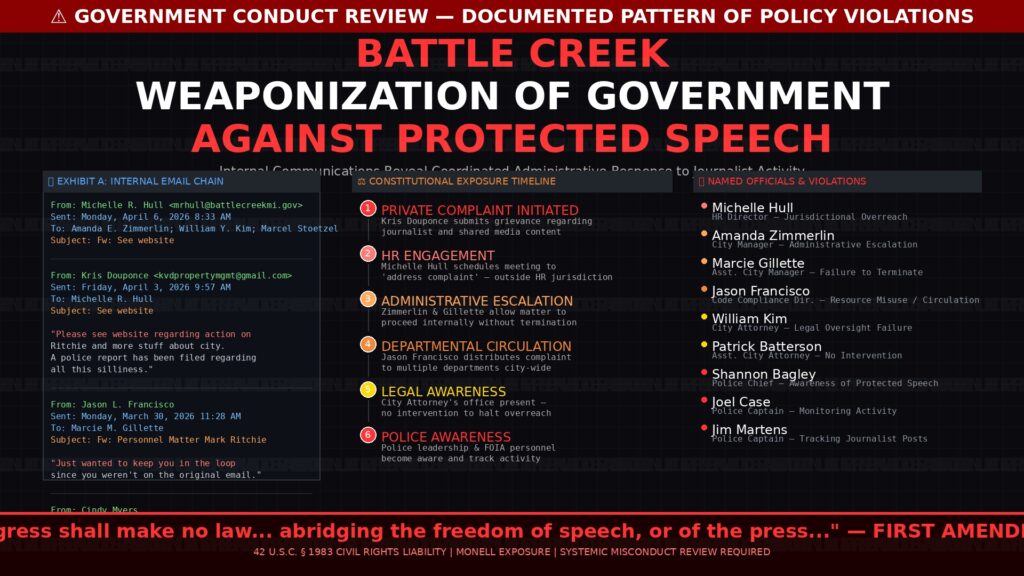
PHOTO ABOVE -Battle Creek: Weaponization of Government Against Protected SpeechThree-Panel Evidence Layout:
📧 EXHIBIT A — Internal Email Chain (Left Panel) Actual quotes from the FOIA’d emails showing Michelle Hull forwarding Kris Douponce’s complaints to City Manager Zimmerlin, City Attorney Kim, and Deputy City Attorney Stoetzel Jason Francisco’s “keep you in the loop” circulation to Marcie Gillette Cindy Myers passing Autumn Smith’s journalist inquiry to Police Captain Joel Case with Chief Bagley CC’d Sandra Dack’s “heads up” to Captain Jim Martens about journalist social media posts
⚖ Constitutional Exposure Timeline (Center Panel) The 6-step escalation from private complaint → police tracking, with color-coded severity Highlights the jurisdictional overreach at each stage
👤 Named Officials & Violations (Right Panel) All 9 named officials with their specific policy violations Color-coded by severity: red for constitutional exposure, orange for administrative failures, yellow for legal oversight gap

|
Dabble VoIP
Business phone for less |
Get Started - mention FAFO for 10% off |
The initial failure point is jurisdictional. City HR authority is limited to internal employment matters and does not extend to private citizens, journalists, or lawful protected speech. Yet HR Director Michelle Hull scheduled a meeting to “address” a complaint involving a journalist and social media content. That act alone crosses the line between internal personnel management and external speech regulation. Once a government entity begins processing protected speech as a personnel issue, it moves into constitutionally sensitive territory where First Amendment protections apply.
From there, the issue expanded rather than corrected. City Manager Amanda Zimmerlin and Assistant City Manager Marcie Gillette allowed the complaint to proceed through administrative channels instead of immediately classifying it as non-jurisdictional. Code Compliance and now Community Development Director Jason Francisco circulated the complaint internally, expanding what should have been a closed matter into a multi-department awareness issue. That dissemination of a private grievance across departments represents a misuse of public personnel systems and City resources under standard municipal ethics frameworks.
The legal oversight layer—William Kim and Patrick Batterson in the City Attorney’s office—operated in an environment where constitutional risk was clearly present, yet there is no documented intervention to halt the escalation or clarify jurisdictional limits. At the same time, police leadership under Chief Shannon Bagley and Captains Joel Case and Jim Martens became aware of or engaged with internal “heads up” style communications referencing journalist activity, raising serious questions about whether protected speech was being informally monitored without a lawful investigative predicate.
FOIA and administrative personnel were also drawn into the internal awareness chain, further blurring the boundary between records management and operational tracking of citizen expression. When multiple departments begin coordinating around a private citizen complaint about a journalist, the issue is no longer isolated—it becomes institutional.
This matters because the City of Battle Creek already has clear disciplinary standards governing employee conduct. Those standards prohibit misuse of public resources, acting outside official authority, and engaging in conduct that exposes the City to legal liability. The City’s progressive discipline system lays out escalating consequences: verbal counseling, written reprimand, suspension, and termination for serious misconduct. None of those standards contemplate City resources being used to process private reputational grievances involving protected speech.
When those policies are applied to the conduct at issue, the pattern becomes difficult to ignore.
HR engaged outside its jurisdictional authority by treating a non-employment speech issue as a matter requiring City response.
Administrative leadership allowed escalation instead of containment.
Code Compliance/Community Development distributed complaint material across departments.
Legal counsel did not halt the process despite clear constitutional implications.
Police leadership and FOIA staff became aware of or participated in internal communications tied to protected speech activity.
Under City policy definitions, this combination implicates misuse of public resources, acting outside scope of authority, and failure to prevent foreseeable legal exposure. The most critical issue is not any single employee action—it is the system-wide participation in a process that treated protected speech as a managed complaint.
|
Need I.T. Support?
Express IT Solutions — Fast & Reliable. |



|
Get Support |
That is where policy violations begin to intersect with First Amendment exposure. Government actors are not permitted to chill, monitor, or administratively process lawful speech simply because a private individual finds it objectionable. When they do, liability does not remain theoretical.
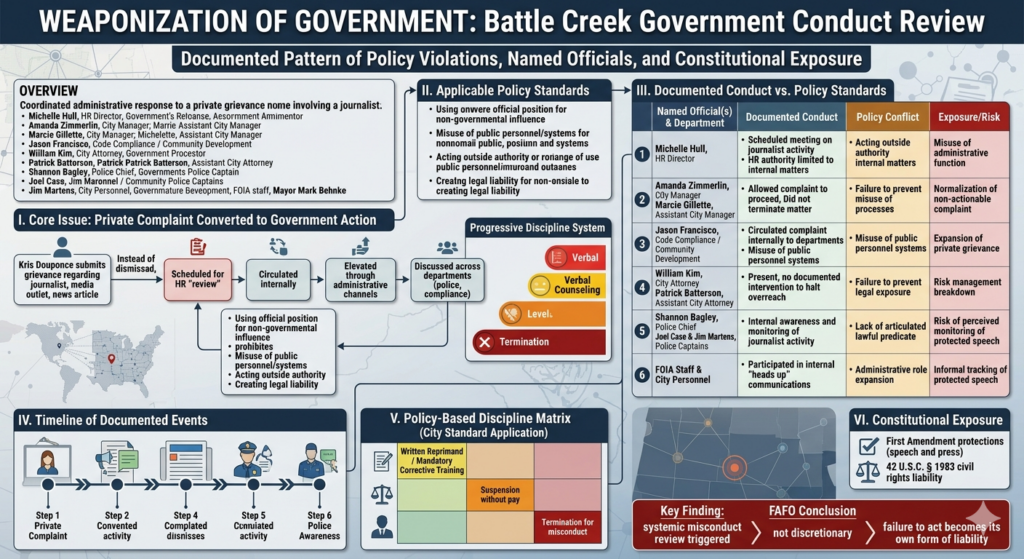
This is why the disciplinary framework matters. Under City of Battle Creek policy, misconduct of this nature does not remain at the level of informal correction. It escalates into written reprimands at minimum, suspension where knowing participation is present, and termination where authority is misused or legal exposure is created. The policy is not optional—it is binding administrative structure.
The larger issue is institutional. When a private citizen complaint about a journalist triggers HR action, administrative circulation, legal awareness, and police visibility, the City is no longer acting as a neutral government body. It is functioning as an enforcement conduit for a private grievance. That is where constitutional scrutiny begins, not ends.
At that point, the legal reality becomes straightforward. Either the City of Battle Creek enforces its own policies consistently across all named departments and corrects the jurisdictional overreach, or it will be forced to explain in another forum why taxpayer-funded systems were used to engage with and process protected speech on behalf of a private citizen.
Because once internal policy lines are crossed at multiple levels of government, the issue is no longer internal discretion. It becomes record, liability, consequence and discovery.