

This Did Not Happen Overnight…
Ten years ago, I was acquitted after what can only be described as a retaliatory second trial. I was charged with disturbing the peace at a city commission meeting—ironically, a meeting I was court-ordered to attend and participate in as part of my sentencing from a prior, unrelated 911 call case. My presence wasn’t optional. My participation wasn’t disruptive. Yet I was arrested anyway.
That acquittal mattered,. I wasn’t disturbing the peace. I was exposing corruption as I was court ordered to do so by Judge Frank Line. But what matters more is what has happened since.
A decade has passed, and despite all the time, lawsuits, warnings, and public testimony, nothing fundamental has changed at City Hall or within the Battle Creek Police Department. If anything, the city doubled down on the worst possible response: multiple false arrests, retaliation, and a stubborn refusal to settle my federal civil rights case when they had the chance.
That decision may go down as the single stupidest mistake the city ever made.
Because now, the roosters have come home to roost.
Today, the City and BCPD are under active FBI investigation for public corruption, among other possible crimes. And I am not on the outside looking in—I am a witness in that case.
This did not happen overnight. Corruption at this level never does.

|
Dabble VoIP
Business phone for less |
Get Started - mention FAFO for 10% off |
Corruption Isn’t Just Behavior—It’s a Culture
When misconduct goes unpunished long enough, it stops being an exception and becomes the norm. Every illegal arrest that’s justified after the fact, every falsified report that goes unchecked, every policy violation that’s ignored sends the same message:
This is how things are done here.
Over time, wrongdoing becomes institutional knowledge. Officers learn that violating policy, lying, or cutting corners isn’t just tolerated—it’s rewarded. It becomes how you advance, how you survive, how you fit in.
“In the past 15 years (roughly 2011–early 2026), news reports document several notable incidents involving Battle Creek Police Department (BCPD) officers breaking the law, engaging in illegal activity, or committing policy violations. These include DUIs by off-duty officers, allegations of cover-ups/corruption/excessive force/evidence destruction, high-level internal misconduct leading to firings, and a recent off-duty intoxicated firearm incident. Many other policy issues or administrative leaves after shootings/uses of force do not result in public criminal/policy violation.”
Here are just a few incidents to highlight the culture that exists. I can speak freely and factually about the details of each of these cases as I was the journalist that investigated them and brought the corruption to light.
2014: Deputy Chief Jim Saylor and Inspector Maria Alonso fired. After a 7-week internal investigation triggered by hostile work environment complaints: intimate/romantic relationship (conflict of interest, favoritism, perceived hostile environment including toward Alonso’s ex-husband officer), lying about the relationship/approvals, policy violations (non-discrimination, electronic communications), improper internal investigations (e.g., excessive force case handling), and destroying/deleting city info (remote-clearing iPads; Alonso deleting women’s locker room video footage, giving untruthful answers). Potential obstruction elements, but handled as policy/employment issues (not criminal charges reported). They sued (due process, etc.); city settled for $161K in 2017 (no liability admitted). Both had long tenures (Saylor ~24 years, Alonso ~18). Note: I was present for some of the federal court depositions of Saylor and Alonso. Evidence I uncovered was used in this case. I also was unlawfully removed from the deposition to which I sued the city for and won.
2018: Officer Chad Francisco off-duty DUI crash (into utility pole in Springfield).
That is exactly why BCPD is operating at roughly 70% staffing.
|
Need I.T. Support?
Express IT Solutions — Fast & Reliable. |



|
Get Support |
Normalization of Misconduct
The most concerning issue is not any single incident, but the breadth of conduct that has been consistently reported, documented, or alleged over many years. Allegations involving lying, civil rights violations, excessive force, racism, sexual harassment, destruction of evidence, falsification of police reports, and other serious misconduct have been raised repeatedly with little to no corrective action.
When such conduct is not meaningfully investigated or disciplined, it becomes normalized. It becomes, in effect, the operating currency of the institution. Officers learn what behavior is tolerated. City officials learn what they can ignore. Oversight bodies learn what they are expected not to question.
This normalization explains why the Battle Creek Police Department now operates significantly understaffed. Ethical officers and recruits who observe these practices conclude—often quickly—that long-term employment requires conformity rather than integrity. Those unwilling to participate leave. Those willing to remain advance.
You cannot recruit or retain good officers in an environment where cadets quickly realize there is no career path unless their top priority is protecting the blue wall of silence instead of the Constitution. Good officers leave. Ethical officers leave. The ones who stay either conform—or burn out.
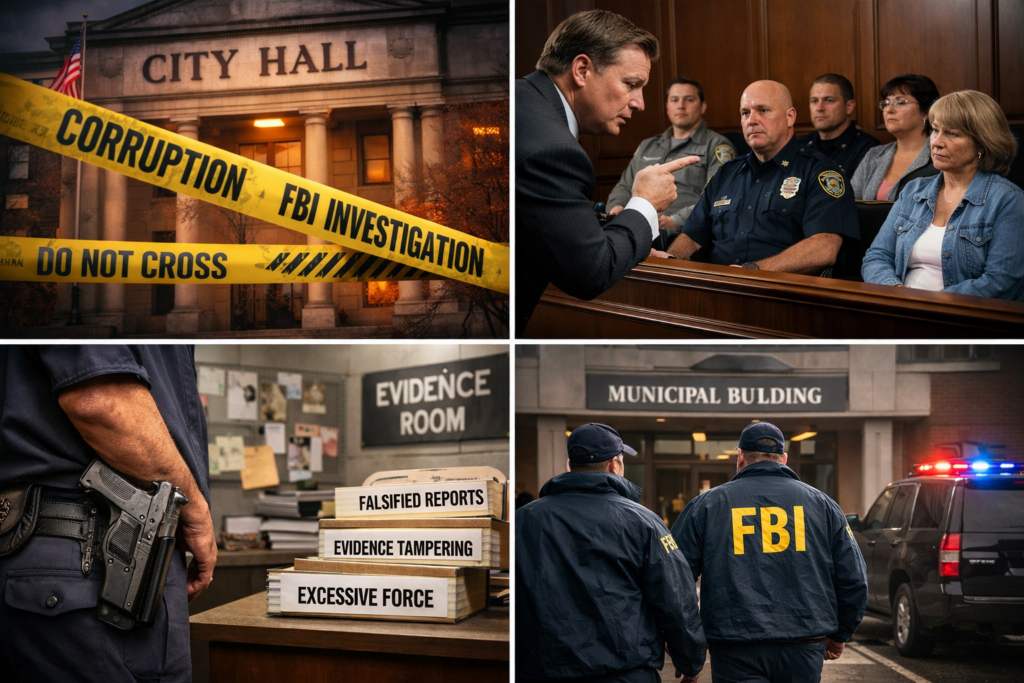
This Doesn’t Happen Without City Hall
This culture is not confined to the police department. It is enabled, protected, and reinforced by City Hall and the City Commission.
These issues do not exist in isolation from city leadership. Effective police accountability requires consistent oversight and independence from political influence. Based on my experience and information provided to me over the years, that separation has not functioned as intended.
I have been contacted over the years by numerous whistleblowers from multiple city departments. Different roles. Different offices. Same story. They confirm what many residents already suspect—but they stay silent publicly out of fear of retaliation and intimidation.
That silence isn’t accidental. It’s engineered.
And it works—until it doesn’t.
Criticism Is Not Hate
I am constantly accused of “hating the city” or “being negative” because I refuse to sugarcoat what is happening. That accusation is lazy—and wrong.
If I truly hated this city, I wouldn’t be over ten years deep into attending commission meetings, filing complaints, speaking on the record, and trying—over and over again—to force accountability. I wouldn’t invest this much time, energy, or personal risk into fixing something I didn’t care about.
The truth is simple: people who don’t care don’t show up.
If You Want to See Who Doesn’t Care, Look at the City Commission
If you want to know who truly doesn’t care about this city, look no further than the nine people on the City Commission. They get elected cycle after cycle, yet nothing ever changes. Votes are scripted ahead of time. Public comment is tolerated, not considered. Everyday citizens are talked at, not listened to.
Real influence in this town is reserved for a small circle of wealthy, connected insiders—business interests and politically intertwined figures operating through incestuous interlocking directorates that quietly run the city behind closed doors.
Everyone else is just there for show.
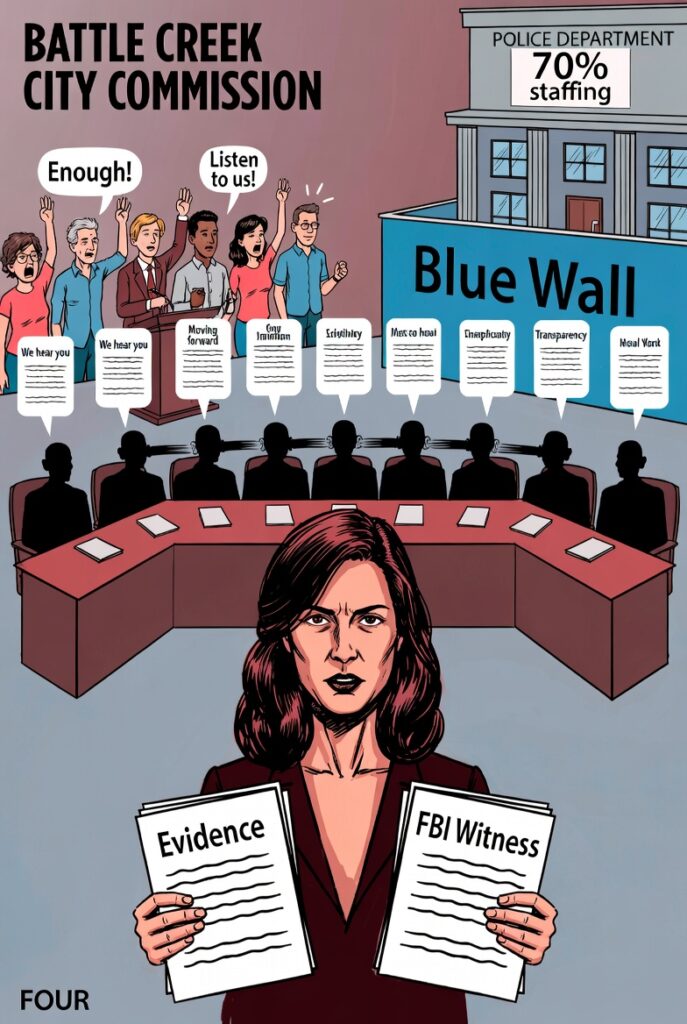
Conduct by the City Attorney’s Office
Concerns extended beyond policing and into the city’s legal apparatus. Prior to my trial, process servers retained in my case observed the city attorney rehearsing and scripting witness testimony as a group inside commission chambers.
This was not preparation of individual witnesses in isolation; it was group coordination. Such conduct raises serious questions about coached testimony and the independence of sworn statements.
History Matters—Because It Explains the Present
Some people want to dismiss events from years ago as irrelevant. They aren’t. They are the foundation of what we’re seeing now.
When illegal conduct is allowed to stand, it teaches the next generation that the behavior is acceptable. When retaliation works, it gets repeated. When oversight fails, abuse escalates.
That is how you end up with federal investigators walking through your city offices.
Today, the City and BCPD are under active FBI investigation for public corruption and potentially other crimes. I am a cooperating witness in that investigation.
Federal scrutiny does not arise from isolated complaints or personality conflicts; it follows sustained patterns of conduct and corroborated information. This investigation did not begin in a vacuum. It is the foreseeable result of years of unresolved allegations, ignored warnings, and institutional resistance to reform.
Until this network of corruption is dismantled and those responsible are held accountable, conditions will not improve. More residents will be subjected to retaliation. More rights will be violated. More trust will be lost.
And whether City Hall wants to admit it or not, the record speaks for itself.
Until then, I will offer this practical advice:
Preserve your records.
Preserve your communications.
Preserve your evidence.
The FBI is in town.
####
[…] A Masterclass in Institutional Impunity: The Unstoppable Rise of Joel Case CONCERNS RAISED OVER POTENTIAL CONFLICTS OF INTEREST IN SACKRIDER MEGASITE DEVELOPMENT Moving Goalposts: How Communities Protect Police Corruption by Attacking Whistleblowers “Speak Into The Mic Bi*ch!” When Police Use Signal, It’s Not About Privacy — It’s About Compliance […]